

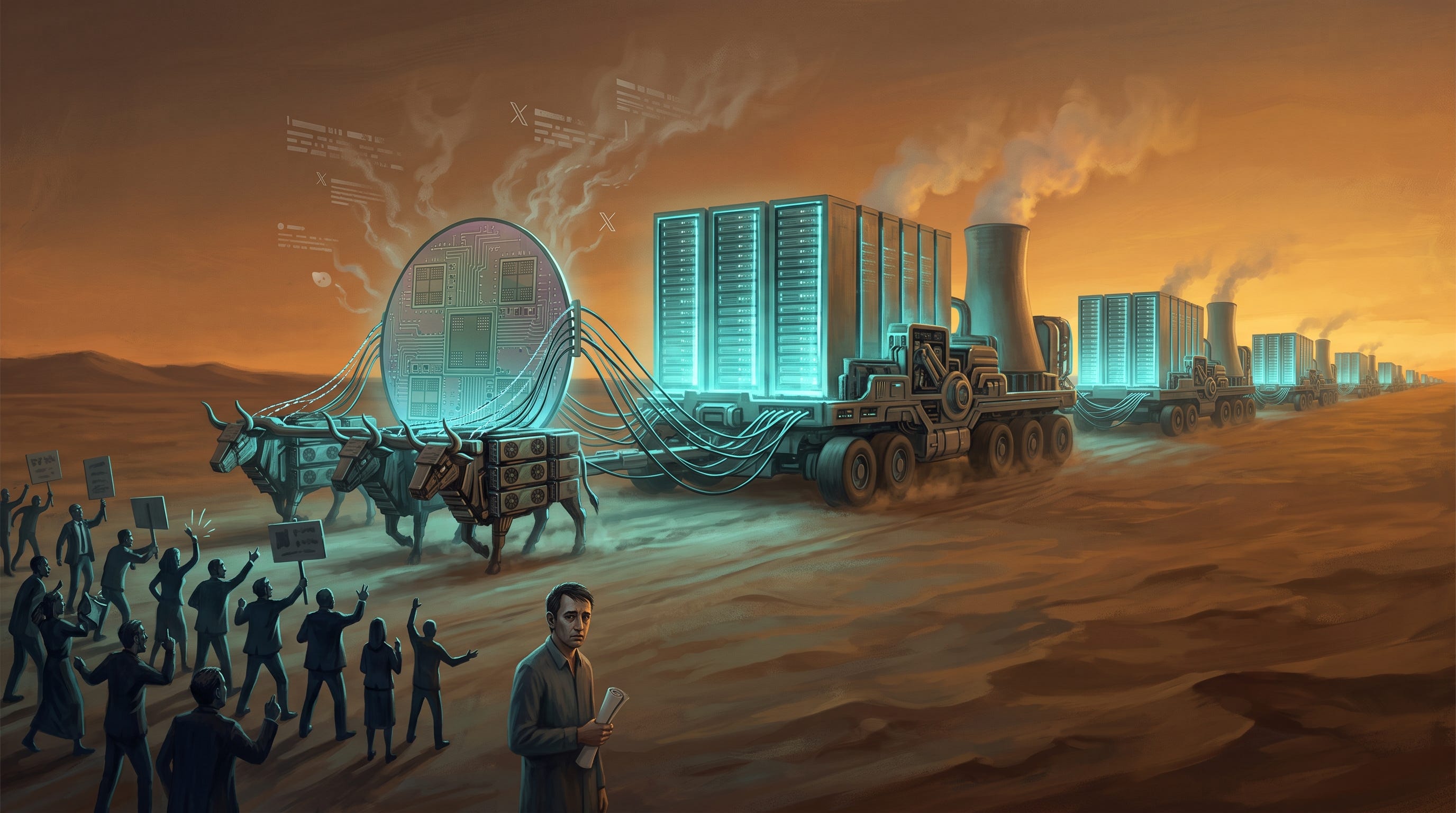
A 27-year-old researcher named Jacob Coxon walked away from Anthropic last week, forfeiting equity that would have vested in roughly sixty days, to publicly accuse the AI industry of “gambling with our lives.” Coxon spent three years on pre-training at both OpenAI (where he co-authored the GPT-4o system) and Anthropic. His statement, carried on CNN’s Anderson Cooper, in TIME, the Wall Street Journal, the BBC, Wired, NPR, the Financial Times, Fortune, CNBC, Axios, and Ars Technica within four days, made a single, technically specific claim: the frontier labs are racing toward self-improving AI that may become uncontrollable inside a horizon shorter than most governance cycles.
His probability estimate, repeated across interviews, is that AI has a greater than ten percent chance of killing all humans. That number is not a rhetorical device. It is the same range his former colleague, Anthropic alignment science lead Evan Hubinger, has put on the record. The man who helped build the systems is the one leaving with the loudest warning. The equity he left behind was the price of saying so out loud.
An unexpected alignment
Within forty-eight hours of Dario Amodei publishing “We Must Pace the Frontier” on September 12, Sam Altman posted on X: “I agree with Dario that we need to pace the frontier. This has been a primary topic of discussions we’ve had at OpenAI in recent weeks.” Elon Musk, Demis Hassabis, Sundar Pichai, and senior Microsoft executives followed in the same window. David Sacks (investor and former Trump AI-crypto czar) wrote, “So go ahead and pace the frontier. You are the ones setting it.” Bloomberg’s today (September 14) headline: “AI Leaders Call For Development Slowdown as Safety Fears Mount.” The Guardian: “AI CEOs say they need to slow the pace of development.”
Wow. The most competitive CEOs in the most competitive industry in the global economy publicly agreed, on the record, that the pace must slow.
What the alignment does not contain is just as important as what it does. There is no joint statement. No binding commitment. No shared definition of “pacing.” Parmy Olson, in Bloomberg Opinion: “AI Needs a Full Stop, Not a Slowdown.” Some of the people closest to the risk think Amodei is too soft. The split is no longer over whether to slow down: it is over what slowing down means and who decides.
The structural posture and the rhetorical posture are not the same posture. In August 2026, Google moved its AI responsibility unit out of DeepMind and into its global affairs organization. A Reuters-cited study in the same window found that Anthropic, OpenAI, xAI, and Meta all fall short of emerging global safety standards. The CEOs can agree on the principle. The organizations they run cannot agree, in their structures, on the practice. When the agreement itself is the news, the substance has not yet arrived.
Asia: Two tracks, one direction
China holds two positions simultaneously and they are not contradictory.
The first is governance rhetoric. At the BRICS Summit in September 2025, Xi Jinping proposed a “consensus-based global AI governance framework” and pledged China’s participation in a BRICS AI open-source community. China has been the most active producer of frontier safety research in 2026: the Concordia AI State of AI Safety in China 2026 report records technical safety output up roughly sixty percent year over year, with the share of agentic safety papers rising from eight percent in early 2025 to twenty-seven percent in Q1 2026. The AI Industry Alliance of China issued voluntary safety commitments on agentic consumer products in February 2026.
The second is rejection of the US-led proposal. On September 14, China’s state-backed Global Times editorial attacked Amodei’s call as a “Cold War tactic” intended “to curb China’s AI development through technological barriers.” Fox News reported that Amodei had compared the AI race with China to the Cold War and called for “disarmament negotiations.” Beijing is simultaneously considering restrictions on outbound access to Chinese AI models, and Anthropic disclosed disrupting a large-scale operation by accounts linked to Alibaba’s Qwen team that used roughly twenty-five thousand fraudulent accounts to bypass regional bans.
The two tracks reflect a single position: China prefers a UN- or BRICS-style multilateral framework over a US-led voluntary framework. On the specific US call to slow down, Beijing’s position is no. Japan, South Korea, and India have been quiet on the matter.
Europe and the US: Three capitals, no bloc
The European Union is the regulatory anchor. The AI Act became applicable on August 2, 2026. The Digital Omnibus postponed high-risk obligations to 2027 after significant Big Tech lobbying. Politico writes: “The EU wanted to lead on regulating AI. Now it’s hitting pause.” EDRi and Amnesty have opposed the rollback. Aleph Alpha signed the EU’s General-Purpose AI Code of Practice. Mistral is ambivalent, advocating a content levy while cautioning about compliance burden.
The United Kingdom is the political accelerant. The Joint Committee on Human Rights, reporting on September 14, called for new AI legislation, declaring the UK “unprepared to deal with potentially dire consequences of AI.” Bloomberg writes: “Can the King Help Persuade Tech Leaders to Slowdown AI?”; King Charles personally engaged. The UK political class has moved faster than the UK frontier-lab class.
The US is the most internally fractured of the three. President Trump publicly criticized the slowdown calls, citing rivalry with China, and the December 2025 White House action on “Eliminating State Law Obstruction of National Artificial Intelligence Policy” pushed the federal posture toward preemption. Colorado’s and California’s AI laws face legal challenge; whether states may regulate AI at all remains unresolved.
But the opposition is mobilizing. On Sunday, September 13, Barack Obama (at a closed-door Democratic fundraiser) warned that AI could be “dangerous” if not properly managed, urged Democrats to make AI one of their “central agendas,” and called for a “very clear plan” for AI safeguards covering safety “slow-downs” and job losses. The New York Times, The Guardian, CNBC, TechCrunch, and NBC News carried the remarks. Obama reframes the US debate from one-party dismissal into an executive-versus-opposition contest. The Republican coalition governs; the Democratic coalition is now organizing around AI safety the way it organized around climate a decade ago.
The “Western bloc” is not a bloc. The EU regulates and softens. The UK legislates and accelerates. The US executive dismisses; the US opposition organizes. Three capitals, two American parties, four vectors, no binding coordination. High entropy.
Capital Markets: The agreement is the news
The capital market reaction is the most precise verdict on the moment. AI stocks fell worldwide on September 14 (confirmed by AP News, Bloomberg, and CNBC) as the slowdown calls landed. The European Central Bank had already weighed in on August 17 with “The AI boom: rational enthusiasm or the next dot-com bubble?” Capital Economics, reported in Barron’s, argues the AI equity boom resembles a late-stage bubble. GMO’s January 2026 note placed the US market in bubble territory. On the other side, Barclays raised its Nvidia price target to $240.
David Sacks publicly endorsed “pacing the frontier” while his portfolio sat in the equities that fell on the endorsement. When the most competitive CEOs in technology publicly agree to slow down and the markets fall on the agreement itself, the agreement is the news. “Pace the frontier” became the new marketing line; markets priced it as a headwind. Hyperscalers cannot slow what their capex is already building. Pension funds cannot slow what their mandates require them to hold. The ten percent probability of human extinction Coxon named is strangely not on any analyst’s spreadsheet.
The supply chain realities
Two physical constraints frame the actual pace at which frontier AI can scale. Neither was moved by the September 12 alignment.
Semiconductors. TSMC’s CEO C.C. Wei confirmed in June 2026 that AI-driven demand is running twenty-five to thirty percent above supply, persisting through at least 2027. The shortage is structural. Data center demand is consuming chip capacity previously available to automotive and industrial customers.
Energy. Global electricity demand is projected to grow four percent annually through 2026 per the IEA, the fastest in over a decade. US data centers are projected to reach six to twelve percent of total US electricity by 2028. Ireland, Singapore, and parts of the Netherlands have imposed moratoriums on new builds. Microsoft, Amazon, and Google have responded by signing nuclear power purchase agreements; a quiet renaissance for fission.
You cannot slow what you keep energizing. The CEOs who signed the September 12 alignment are employed by the same companies signing the nuclear PPAs that remove any physical ceiling on capability scaling. A coordinated slowdown by US labs without Chinese participation would not slow the global pace: it would shift it.
Political coordination: Not on any table
The “global pause” Coxon’s warning implicitly invokes is not on any government’s table. The EU has postponed its own obligations. Trump opposes. The UK supports legislation but cannot bind the United States or China. Xi prefers a BRICS framework that excludes the United States. Four vectors and four capitals, no binding coordination.
The current alignment is informal: X posts, op-eds, Bloomberg headlines, rants everywhere. It is not a document. The Hinton-Bengio camp remains a signatory to the Center for AI Safety Statement on AI Extinction Risk, but no new coordinated September 2026 statement has emerged.
The headline drama of the past week will cycle through. Coxon’s warning will be cited, debated, and forgotten by the next announcement cycle. The CEO alignment of September 12 will be quoted in earnings calls and absorbed into the marketing of “responsible scaling.” Obama’s intervention will become a Democratic Party platform plank. What will not cycle is the operational governance work (the maturity programs, the evidence architectures, the framework selections) that organizations either built or did not build while the headlines were running.
The most durable response to a CEO letter is not another CEO letter. The most durable response to a resignation is not a coordinated statement. The next four years will not be decided in San Francisco boardrooms or Davos panels. They will be decided in the unglamorous work of mapping obligations to controls, producing evidence that survives regulatory scrutiny, and integrating AI governance into existing operational risk and quality systems. The headlines cycle out. The infrastructure compounds.
As we say in French: “les chiens aboient, la caravanne passe.”