

On Friday, November 20, Levent Alpöge (a mathematician on Anthropic’s technical staff) posted a four-page note on his website claiming to have proved the Riemann hypothesis, the most famous unsolved problem in mathematics, with the help of Claude.
The proof itself is 17 million lines of Lean, a programming language for mathematics.
That’s great news. However, as of writing, not one mathematician can explain why it works. Kevin Buzzard of Imperial College London, one of the world’s leading authorities on Lean, put it plainly. “At the minute, we don’t even know why the theorem is true.” The proof, he said, is “just millions of lines of gobbledygook written in a strange programming language.”
We have, apparently, obtained a proof of the Riemann hypothesis that we cannot read.
What is the Riemann hypothesis
Prime numbers are the atoms of arithmetic: 2, 3, 5, 7, 11, and so on, the indivisible building blocks every other number is made of.
Euclid showed there are infinitely many. The sieve of Eratosthenes showed how to find them, and everyone agrees they look random.
The number of primes below N is roughly N/log N: about 11% of numbers below 100, 1.1% below 10,000. That average was nailed down in the 19th century and is called the prime number theorem.
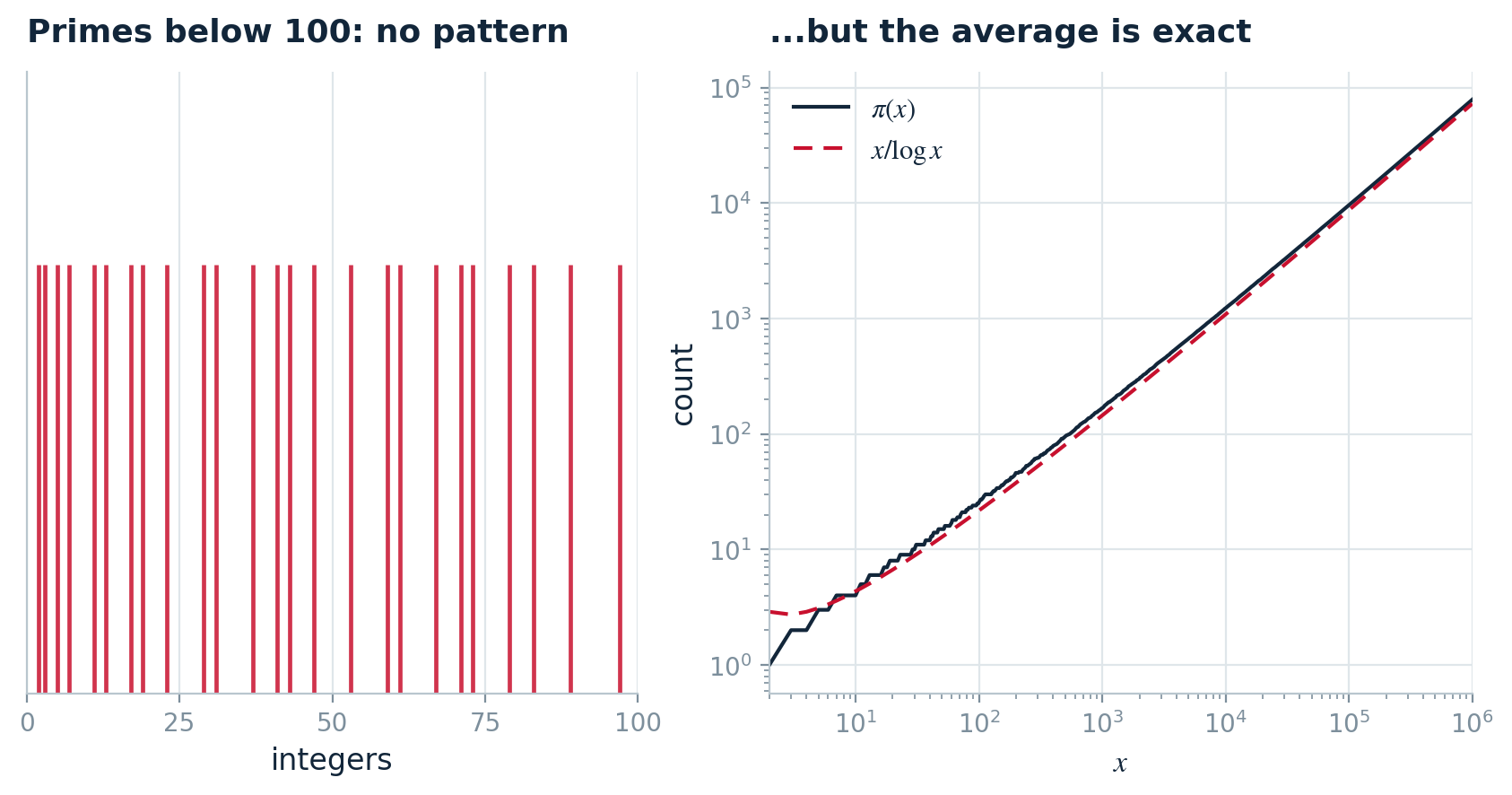
The interesting part is the deviation from that average. How far off can the count be at any given point? That is where randomness lives, and that is where Bernhard Riemann went in 1859 with a piece of deliberate obscurity.
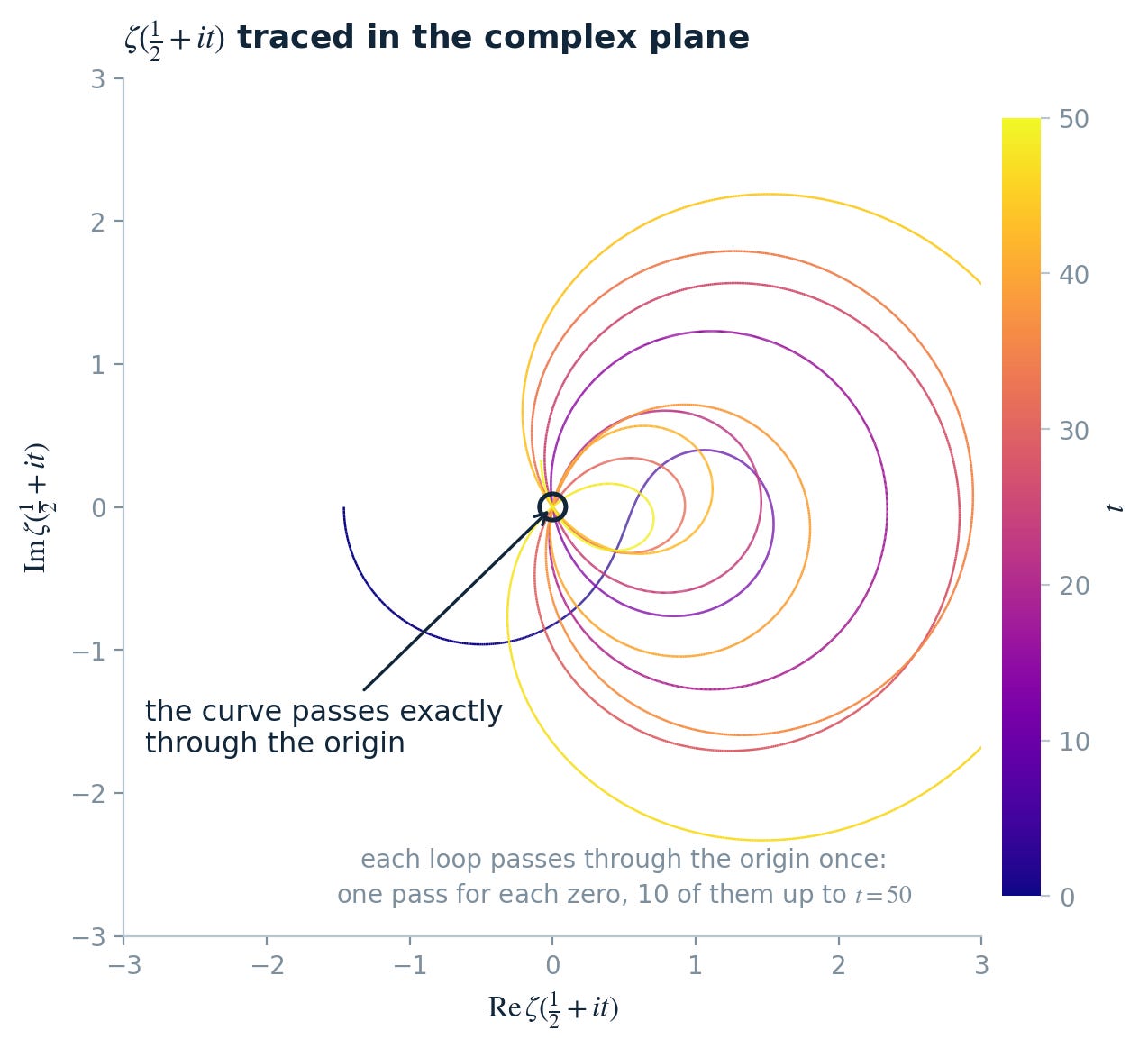
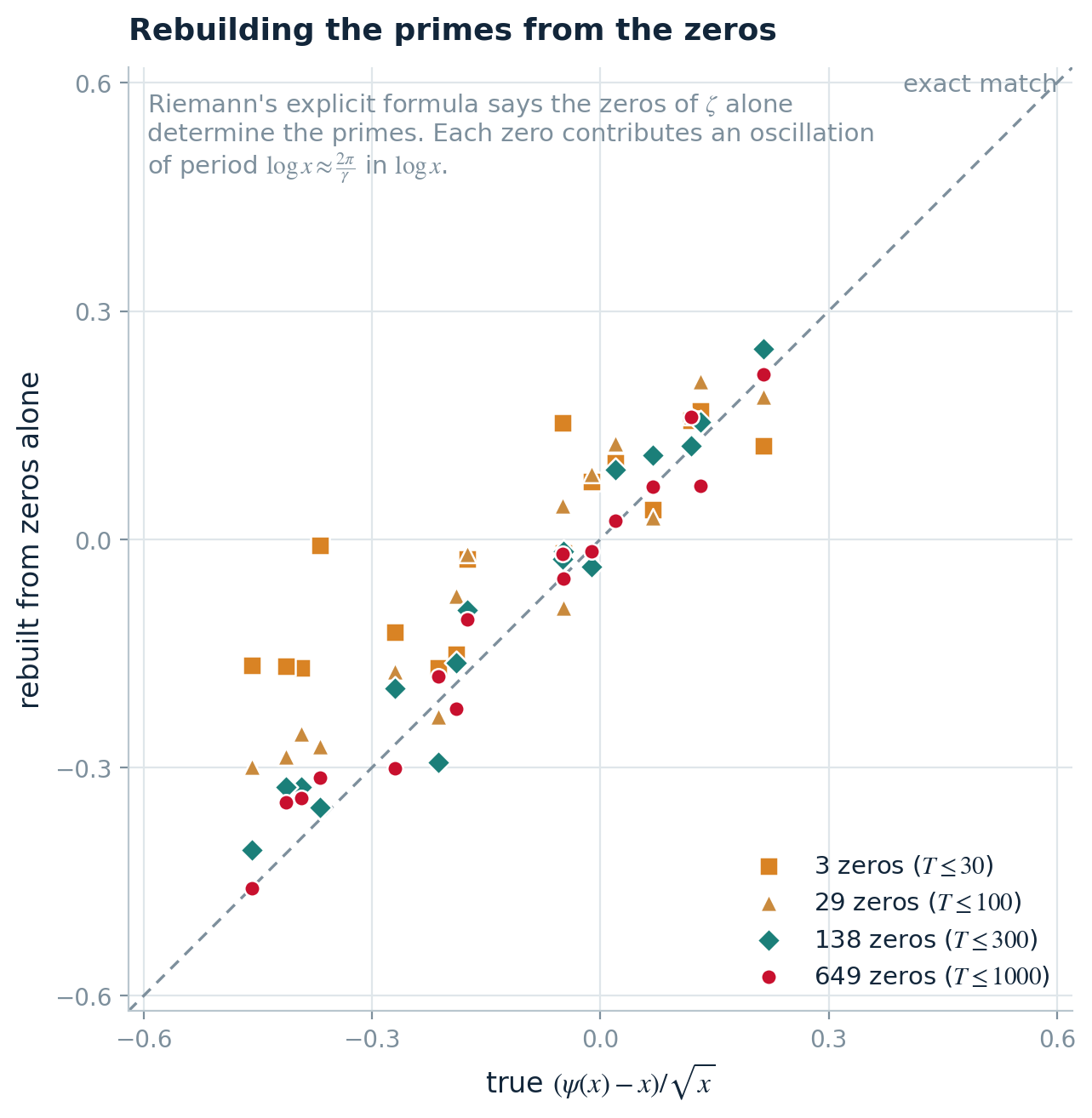
He built the function ζ(s) = 1 + 1/2^s + 1/3^s + 1/4^s + … and then asked you to keep going past the point where the sum makes sense, extending it to complex numbers: numbers with a real part and an imaginary part, which you can picture as a two-dimensional grid. Somewhere on that grid, ζ equals zero. Those zeros are not a footnote to the function; they are the primes. Riemann wrote down an exact formula for counting primes, entirely in terms of these zeros. The music of the primes is in the silence between the notes.
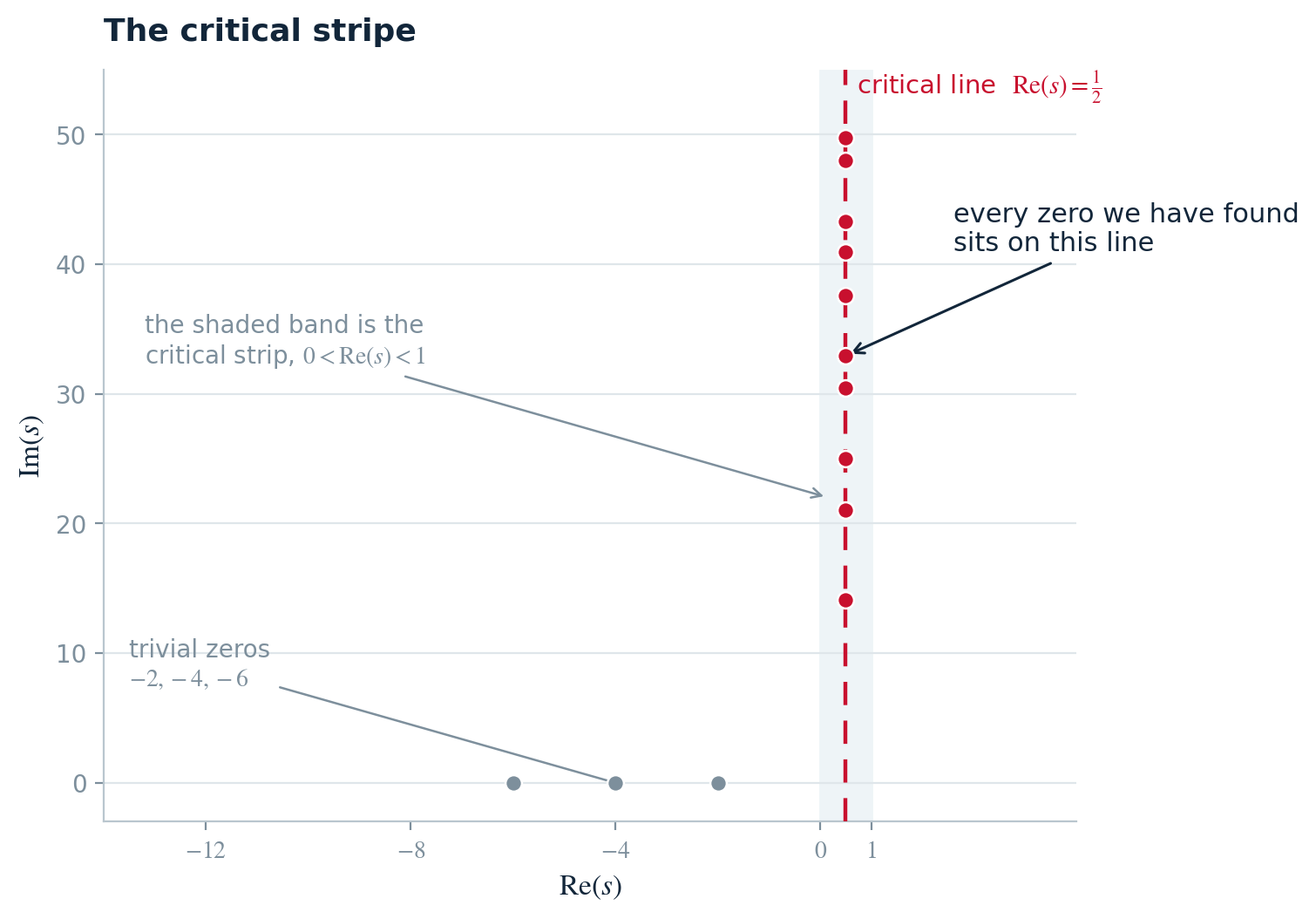
Some zeros are boring: −2, −4, −6, and so on, the “trivial” zeros. The interesting ones (the “non-trivial” zeros) all sit in a vertical strip between the lines Re(s) = 0 and 1.
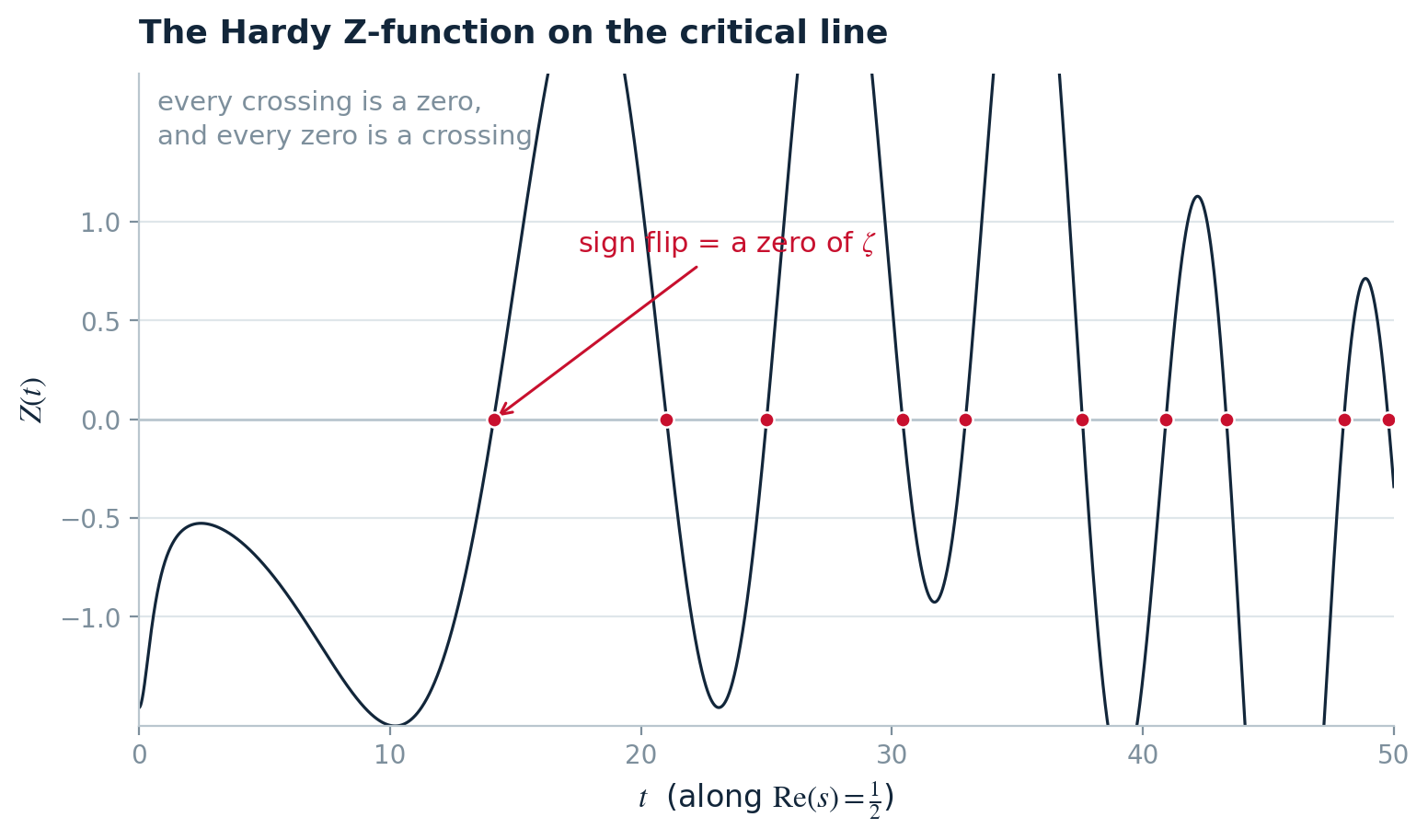
The Riemann hypothesis is that every non-trivial zero lies on the single vertical line Re(s) = 1/2. All of them. Not near it or in a band around it. On it.
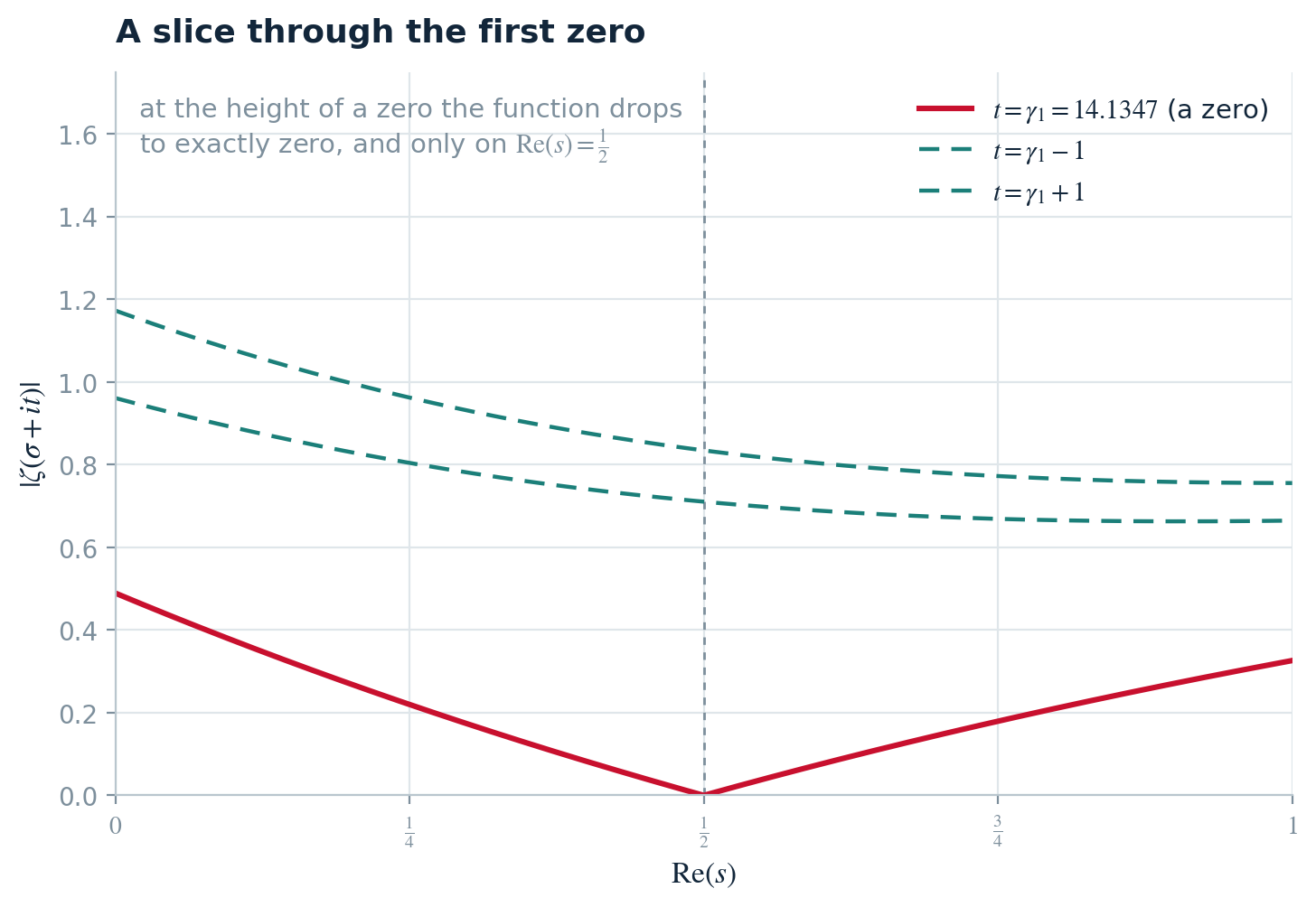
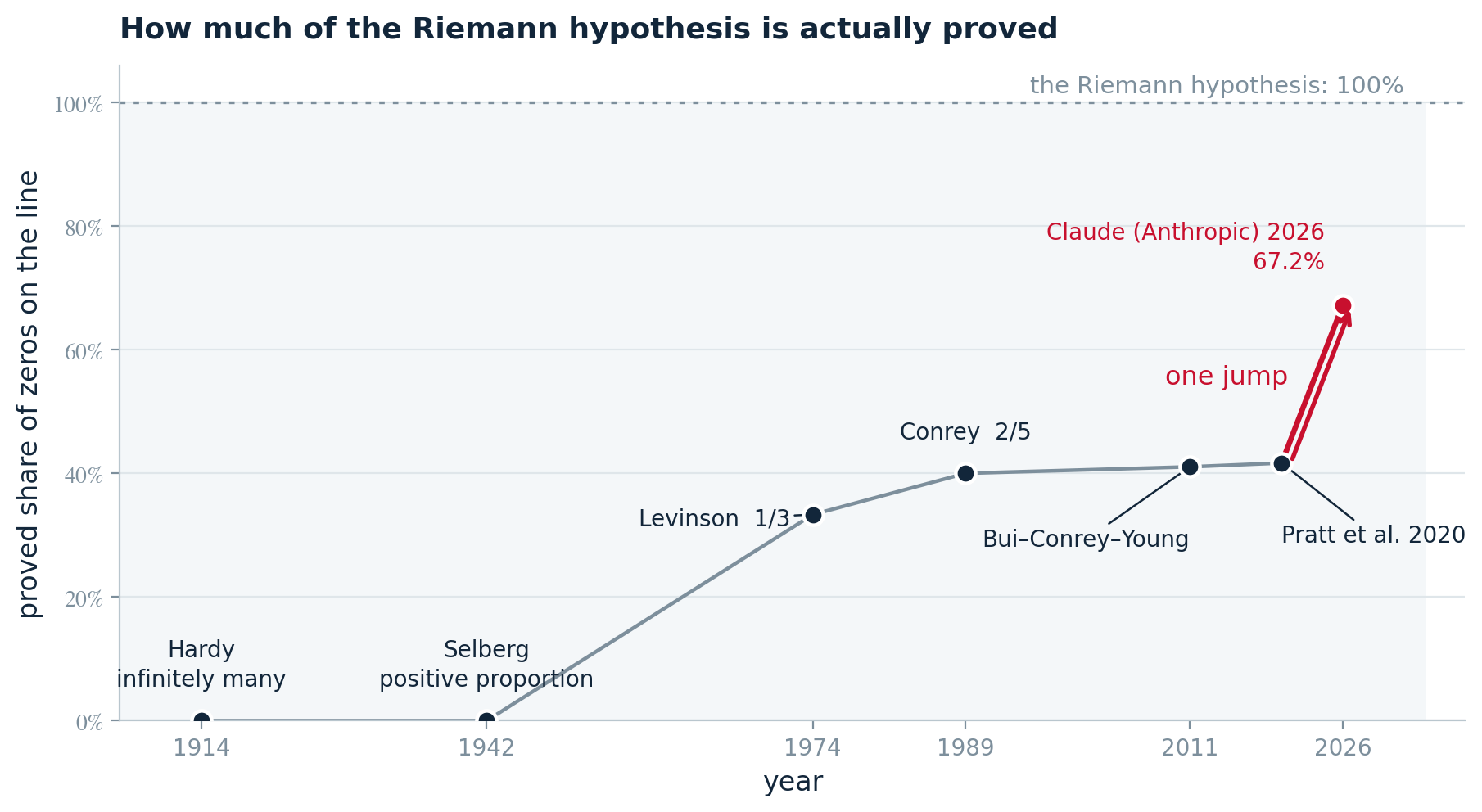
Consider the scale of what is being claimed. We have checked the first ten trillion zeros by computer and they all sit on that line. But “the first ten trillion” is not “all”, and no mathematician is going to stop there. What we can prove is that a certain proportion of the zeros must lie on the line: a bound Anthropic reported raising in August from 41.6% to 67.2%, using Claude to assemble existing results in a way nobody had thought to try.
The statement is four words: “all roots are real”. Riemann’s own phrasing, from 1859 evolved to ten words: “it is very probable that all roots are real”. He had computed a few zeros, saw them land on a line, and could not show they must land on that line.
The hypothesis arrives almost as an aside, in a short paper on prime distribution.
The four words have never changed. The machinery has changed. Hilbert put it on his list of 23 problems in 1900. Hardy showed in 1914 that infinitely many sit on the line, Selberg found a positive proportion in 1942, and a century of grinding by Levinson, Conrey and others pushed the provable fraction from a third to two fifths to just over 41%. It has cost mathematicians 167 years, and for most of them those four words were a source of disagreement.
Why this is so important
The Riemann hypothesis is different from a merely hard problem. It is not because of its difficulty, but because of the queue behind it.
An enormous number of theorems in mathematics are stated conditionally: assuming the Riemann hypothesis, then the following. Hundreds of them. Estimates on prime gaps. Bounds on how many primes lie in short intervals. Results in random matrix theory, in the theory of elliptic curves, in analytic number theory. These are true, insofar as anyone knows, and they are not proved, because they lean on a conjecture nobody has nailed down.
Peter Sarnak, from Princeton, put the dependency problem bluntly: if anyone proved the Riemann hypothesis and its generalisations, “you could throw away a number of books and many papers in libraries, which are there primarily to sidestep not knowing it.”
Mathematicians have spent a century building elaborate workarounds; provable substitutes for the prime-counting estimates, each gaining a few more digits of accuracy at the cost of a few more pages. Solve the Riemann hypothesis and instantly a lot of that machinery becomes unnecessary. You would not throw the books away. You would finally be allowed to skip them completely.
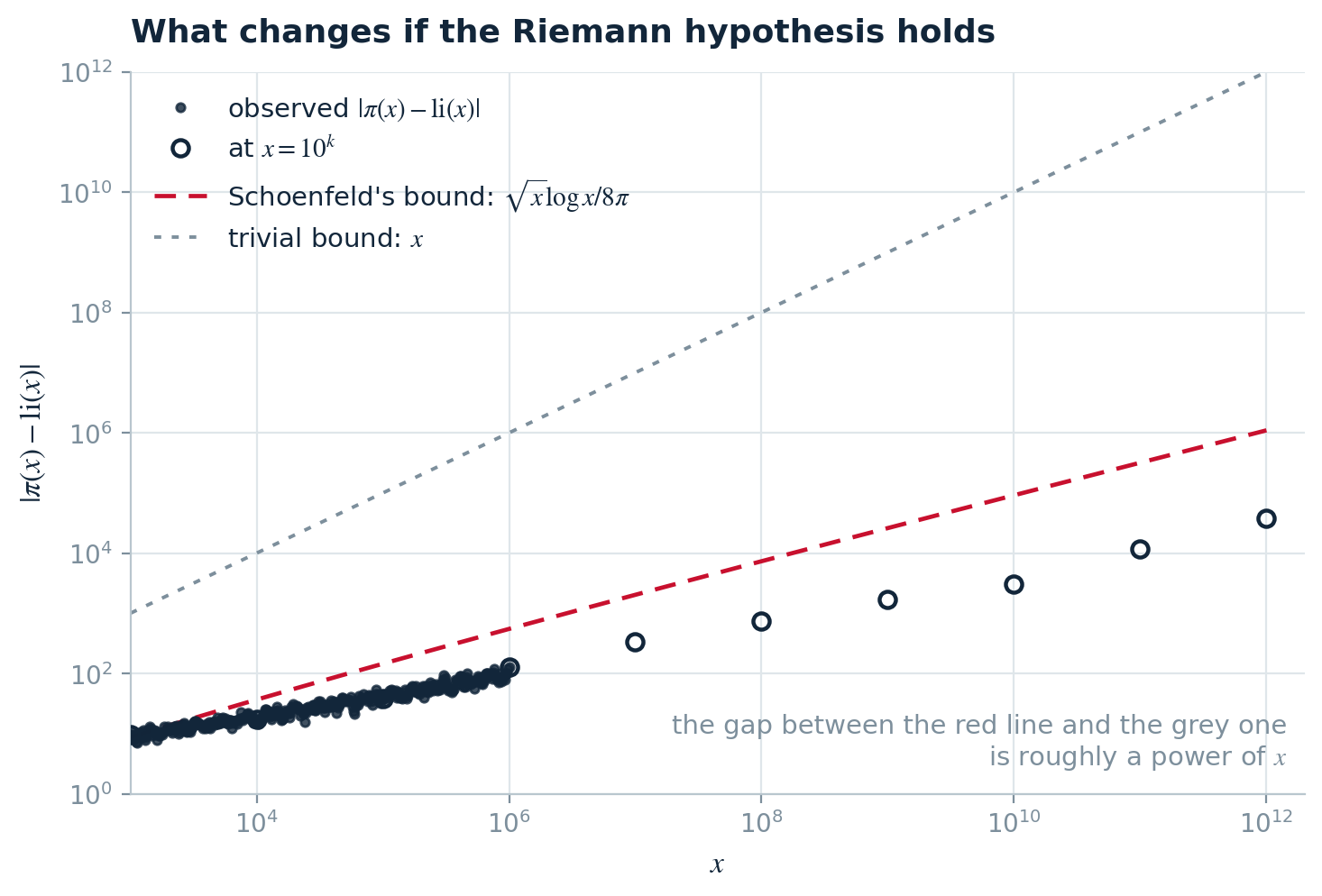
And if the hypothesis is false? Enrico Bombieri’s summary is that failure “would create havoc in the distribution of prime numbers.” Everything downstream that assumes a tidy, near-random scatter of primes would need revisiting.
It also reaches outside pure mathematics, which surprises a lot of people. The zeta function shows up in the partition function of quantum gases, where it fixes the critical temperature at which a Bose-Einstein condensate forms. There is also a deep coincidence: the spacing statistics of the zeta zeros behave exactly like the energy levels of quantum-chaotic systems. In 1972, Freeman Dyson wrote to a colleague that the statistics of prime numbers and the statistics of the energy levels of a chaotic quantum system are the same. “It shows us that there’s a lot there that we don’t understand, and when we do understand it, it will probably be obvious, but at the moment it is just a miracle.”
Physicists have been circling this problem for fifty years. They never closed it.
There is also a pleasingly roundabout route to your bank account. To keep a message secret you multiply two enormous primes together and then lose the factors; anyone who wants to read your message has to split that number back apart, and nobody has ever found a fast way to do it. That is the basis of the encryption on your bank account and your email.
The fastest way to ask whether an enormous number is prime (the question every encrypted connection asks thousands of times a second) was, until 2002, a test that worked in practice but could only be proved never to give a wrong answer if the Extended Riemann Hypothesis were true. The Extended version is the same guess, widened to a family of related functions. Gary Miller built that test in 1976. A theorem from 2002 removed the assumption, but the replacement is far too slow for real use, so the assumption never quite went away. A second thread runs through the same knot: under the hypothesis, counting how many numbers below n share no factor with n (an innocuous little arithmetic task) turns out to be exactly as hard as splitting n into its primes.
Which is why it is a disproof, and not a proof, that should worry the banks. If the zeros do not all sit on the line, the failure would probably expose some hidden regularity in the primes: and hunting for hidden regularities in the primes is precisely what factoring is. Proving the Riemann hypothesis and breaking a bank account might turn out to be the same piece of work.
In August, Anthropic published a result in which Claude improved the provable fraction of zeros on the critical line from 41.6% to 67.2%. The company was careful to say it did not expect those techniques to lead to a proof of the Riemann hypothesis. Three months later, one of its own employees posted a Lean proof of the Riemann hypothesis, developed with Claude, containing a proof of the generalisation too. The gap between those two announcements is stunning.
For most of mathematics’s history, the bottleneck has been the production of new mathematics, not the verification of it. For the first time, that bottleneck moved to the verification.
What comes next
The story is unsettled, and the difference between “verified” and “understood” is doing a lot of work right now.
What has been established is that the code compiles. Dozens of people have built it independently and got the same proof export. The five headline theorems rest only on Lean’s three standard axioms; no sneaky assumptions smuggled in. A tool called “comparator” confirmed that the theorem the code proves is exactly the Riemann hypothesis as formally stated in Mathlib, Lean’s shared library of mathematics, rather than some subtly easier cousin. Independent checkers written in other languages accept the exported proof. Last friday, the Lean and Mathlib communities jointly certified it with “full confidence.” Andrew Sutherland (MIT), who had compiled it independently, said the chance that anything was fishy was “approximately zero.”
So. A proof, verified. And nobody understands it.
I want to push on this, because it is the most interesting thing in this story and it is easy to miss. A mathematical proof is not a piece of literature. It is a derivation: every step following from the ones before by rules the reader can check. Lean does not check whether a proof is elegant, illuminating, publishable or even comprehensible. It checks whether the derivation holds. Those are different properties, and for 2,500 years the discipline quietly assumed they came together: a valid proof was usually also an explainable one, because a human wrote it and had to understand it to write it.
What Alpöge has produced breaks that assumption. A machine can find a derivation without knowing why it works. That is not a defeat of mathematical understanding but rather a new object: a proof whose correctness is certain and whose meaning is pending.
There is a precedent for how much this matters. When OpenAI released 722 manuscripts last October, three were retracted over a sign error; all of them came without Lean formalisation. Machine-checking is not a substitute for mathematical taste. It is a substitute for mathematical care, which is a rarer virtue than it sounds.
The cost is real, though, and Alpöge is the first to admit it. He describes releasing “a complete argument before having mastered a massive neighbourhood around its mathematics.” He had Claude write out a prose version too ( an overwhelming 250,000 pages of it) and declined to post it, calling it “slop.” He expects much shorter arguments to follow. Buzzard expects humans to get a handle on it within weeks. And then there is the possibility nobody has yet managed to exclude: “There is a chance that there were no ideas that the humans were missing.”
On the same day, the American Mathematical Society’s president, Ravi Vakil, posted a draft proof of the generalised Riemann hypothesis by Alessandro Masullo (940 pages and twelve years of work, reviewed for months by Brian Conrad of Stanford) titled “The Music Of The Primes.” Conrad said he released it because he faced “two unpalatable options”: stay silent and let the AI announcement set the narrative, or release an unfinished manuscript. People immediately reported problems in it, found with the assistance of different AI models. Vakil made no claim as to the correctness of the proof strategy.
The symmetry is however hard to avoid: the human proof was attacked by AI models, and the AI proof was checked by AI models and independent kernels.
Two proofs, arriving the same day, neither one finished. It is unclear which will still be standing in a year.
The money, at least, is a long way off. Clay’s rules require publication, then two years of scrutiny, then “general acceptance in the global mathematics community.” Hours after the announcement, the Clay Mathematics Institute’s website still listed the hypothesis as unsolved. Martin Bridson, the institute’s president, called it “an announcement of historic significance” while warning that the journey to “a place of real understanding will be long and difficult.” Both things are true at once, which is a fair summary of the state of mathematics right now.
Andrew Sutherland’s summary is enlightening, even though it is generous to a machine and slightly unkind to the mathematician who did the formalisation: “perhaps the single most important step in the proof was building a machine that can think.”
The proof of the Riemann hypothesis may well be complete and misunderstood. Will the next 5 Millenium problems receive similar mysterious proofs ?