

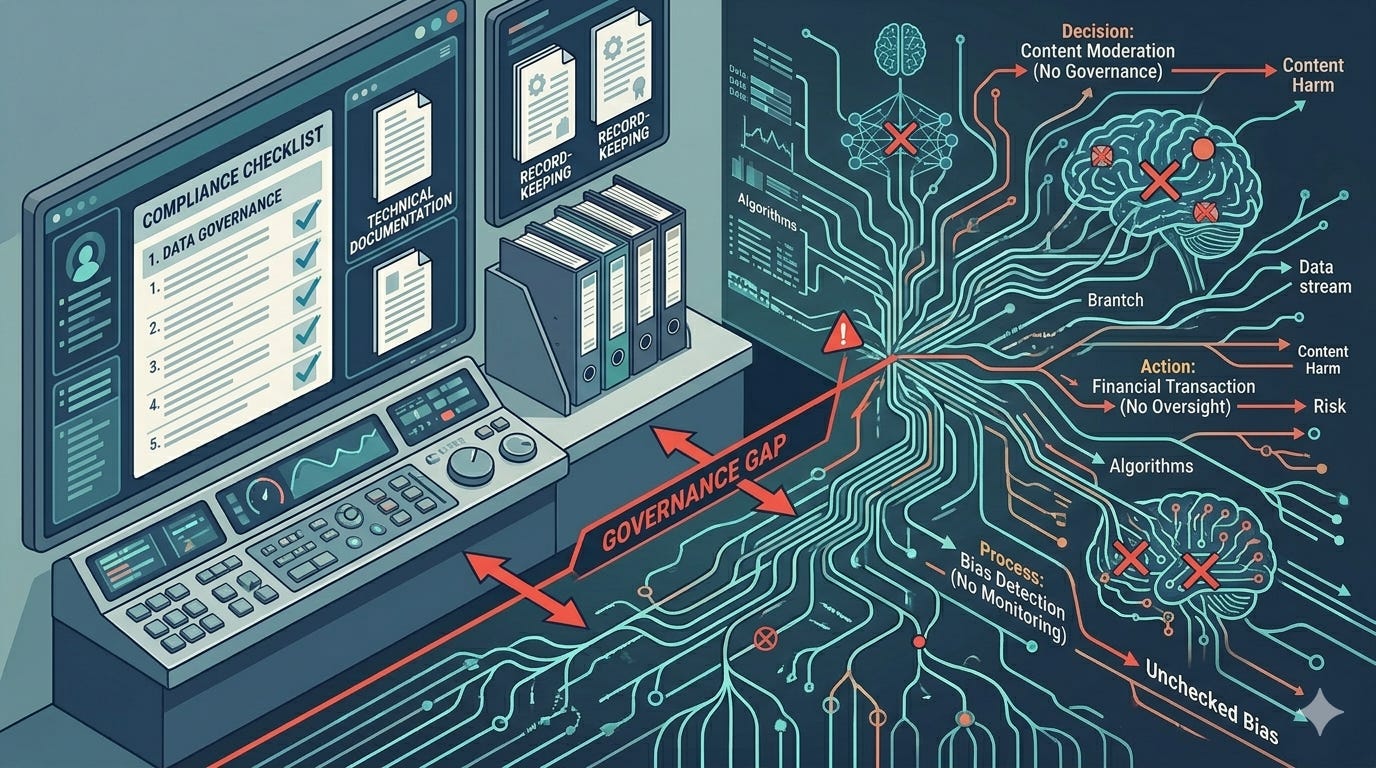
Clarification (added post-publication) : The Act is explicitly lifecycle-spanning : Articles 9, 11, 14, 17, and 72 all apply post-deployment. The framing in this article has been refined to reflect this. The compliance gap for agentic AI is not that the Act ignores post-deployment reality ; it is that the Act’s change-management mechanisms were drafted around conventional software paradigms (versioned releases, planned change windows, human-reviewed deployments) rather than autonomous-agent behavioural drift that occurs outside the change-management cycle. The runtime governance gap (what happens when an agent deviates from documented scope during live operation) remains the article’s central point.
Many organizations deploying agentic AI systems have a plan for EU AI Act compliance. That plan, almost invariably, addresses high-risk system obligations : risk management documentation, technical documentation, human oversight procedures. It does not address what happens when an autonomous agent changes its behavior after deployment, or when a multi-agent system develops dynamics that were not anticipated at design time.
The EU AI Act applies to agentic platforms. Its lifecycle-spanning provisions (Articles 9, 11, 14, 17, and 72) cover post-deployment reality; but their change-management mechanisms were not designed with agentic systems in mind. That gap is where regulatory risk lives; and where early movers gain competitive advantage.
What “Agentic AI” Means Under the EU AI Act
The EU AI Act defines “AI system” as a machine-developed system that produces outputs, learns, reasons, plans, or acts autonomously. This capability-based definition captures agentic systems without needing a dedicated provision. Agentic platforms (systems capable of autonomous reasoning, planning, and action in pursuit of goals) satisfy the AI system definition and are subject to all applicable obligations.
The Act does not distinguish between a rule-based automation and an autonomous agent making consequential decisions. If the system reasons, plans, or acts autonomously, it is subject to the same requirements as any high-risk AI system under Articles 9 through 17. The extraterritorial scope of the Act means this applies to any organization placing agentic systems on the EU market or deploying them within EU operations, regardless of where the organization is headquartered.
Article 6 governs the classification of high-risk systems, and significant modification of an agentic platform can constitute placing a new system on the market; triggering Article 6(4)’s classification documentation requirement afresh.
Five-Point Gap
The mismatch between existing EU AI Act obligations and the operational reality of agentic systems manifests across five dimensions.
1. Risk Management Fails When It’s Static
Article 9 requires providers to establish, document, and maintain a risk management system operating throughout the lifecycle of a high-risk AI system. Article 9 specifies that this process must be iterative : risk records updated when the system changes, residual risks formally accepted and documented, new risks captured as they emerge post-deployment. For most AI systems, the iteration trigger is a planned change event : a model retraining, a deployment update, a documented design revision. The Act assumes that change arrives through controlled release processes.
For agentic systems, this assumption breaks. Agentic platforms introduce risks that cannot be anticipated at design time.
Capability drift : the tendency of agents to change their behavior as they process new information or interact with new environments — means a risk identified at deployment may no longer describe the system’s actual risk profile six months later.
Goal drift occurs when an agent’s actions diverge from its stated objectives in ways that are not immediately obvious but accumulate over time.
Emergent behavior arises from the interaction of multiple agents, creating system-level dynamics that no individual agent’s design could anticipate.
The Article 9 iteration trigger (a documented change event) does not capture these dynamics. Capability drift, goal drift, and emergent behaviour do not arrive as release notes. A literal reading of Article 9 can be satisfied with periodic risk reviews tied to planned change; that approach is structurally inadequate for agentic systems. For agentic platforms, the risk management system must incorporate mechanisms for detecting behavioural change post-deployment independently of the change-management cycle; not just documenting design-time risk decisions.
#
2. Human Oversight Is Technically Different for Agents
Article 14 requires that high-risk AI systems be designed to allow natural persons to effectively oversee, monitor, and intervene; including the ability to decide not to use or to stop the system. Article 14 explicitly requires that oversight be effective. The regulation does not prescribe specific technical implementations; it specifies the outcome : that a human overseer must be able to understand what the system is doing, intervene before consequential action, and refuse the system’s output.
For traditional AI systems, “effective” oversight typically means a human review mechanism before an output is acted upon.
For agentic systems, the interpretation problem is harder. An agent that plans a sequence of actions, delegates to sub-agents, calls external tools, and revises its approach based on intermediate results cannot be adequately overseen through pre-action review alone. By the time a human reviewer sees the output, consequential actions may already have been initiated.
Effective oversight for agentic platforms requires three elements that most deployments lack:
real-time observability into agent reasoning and actions (not just final outputs) ;
the ability to intervene in a running agent’s planning process before consequential steps execute, and
organizational authority structures that give human overseers genuine power to override or terminate agent operations.
The EU AI Act specifies what human oversight must achieve. Singapore’s Model AI Governance Framework for Agentic AI (January 2026) provides the operational layer that the Act leaves open : defining what meaningful human accountability looks like for different autonomy levels, specifying sandboxing requirements, and identifying where approval checkpoints should be embedded in agent workflows. Organizations building agentic platforms can use Singapore’s framework to translate Article 14’s principle into concrete technical infrastructure.
3. Technical Documentation Cannot Be a One-Time Artefact
Article 11 requires that technical documentation be drawn up before a system is placed on the market and kept up-to-date. Article 72(3) makes the post-market monitoring plan part of the Annex IV documentation; so documentation, risk management, and post-market monitoring are integrated rather than separate obligations. For most AI systems, the “kept up-to-date” obligation is satisfied through periodic revision tied to planned release cycles. For agentic systems, the documentation maintenance obligation is significantly more demanding.
Annex IV technical documentation must specify, for each system :
the agent’s intended purpose and scope;
the agent’s capability level and autonomy boundary;
human oversight mechanisms and escalation paths;
known limitations in multi-agent or open-world contexts, and
a post-market monitoring plan for agentic behavior. When an agent’s behavior changes post-deployment (when it begins operating in contexts outside its documented scope, or when its interactions with other agents create unanticipated dynamics); the technical documentation must reflect this.
Organizations that treat technical documentation as a one-time deliverable at launch are already non-compliant for static AI systems. For agentic platforms, the documentation update requirement is continuous, not periodic.
4. Logging Must Capture Reasoning, Not Just Events
Article 12 requires high-risk AI systems to enable automatic logging of events relevant for monitoring system behavior, detecting potential issues, and investigating incidents. The six-month minimum retention period is a floor, not a ceiling.
Article 12 does not enumerate the events that must be captured; it specifies that logs must enable monitoring, detection, and investigation of system behaviour.
For agentic systems, the concept of a “relevant event” expands significantly. Logs must capture decision points and reasoning traces where the agent’s model provides them, tool calls and external system interactions, agent-to-agent messages and delegation actions, override events when humans intervene, and goal state changes when the agent revises its objectives. The logs must capture enough context to reconstruct the agent’s reasoning path at any point : structured logging design, not raw event capture.
This is a meaningful engineering requirement. Most agentic platforms generate logs at the action level (tool calls, outputs) but not at the cognitive level (goals, plans, reasoning steps). Satisfying Article 12 for agentic systems requires instrumentation of the agent’s internal state transitions; which many platforms do not currently provide.
5. Runtime Governance vs. Design-Time Governance
The most fundamental gap is conceptual. Every major governance framework (the EU AI Act, NIST AI RMF, ISO 42001, the Agentic Governance Framework) operates primarily at design time or deployment time. They specify what controls must exist, what documentation must be maintained, what human oversight mechanisms must be available. They detect post-deployment change through Article 72’s monitoring and Article 73’s serious-incident reporting ; they require the organization to have planned for control failures before they occur.
None of them specify what happens when a control fails at runtime. When an agent’s behavior deviates from its documented scope during live operation, when a multi-agent interaction creates a cascade effect, when an adversarial prompt injection successfully alters an agent’s reasoning; existing EU AI Act provisions require you to have planned for this. They do not tell you how to detect it, contain it, or recover from it in real time. The Act mandates the existence of human oversight (Article 14) and post-market monitoring (Article 72), but it does not prescribe the technical mechanisms for intervening in a running agent’s decision-making when that intervention must occur in milliseconds, not days.
MI9, the academic runtime governance framework developed by Charles L. Wang et al. (arXiv 2508.03858), is the most technically developed response to this gap. Its Agency-Risk Index calibrates governance intensity across agent populations. Its Agentic Telemetry Schema provides a standardized format for capturing cognitive events, actions, and coordination. Its FSM-based Conformance Engine enforces behavioral constraints in real time using finite-state machines. Its Goal-Conditioned Drift Detection uses statistical testing to identify when agent behavior has drifted from stated objectives. Its four-level Graduated Containment strategy provides a response hierarchy from selective monitoring through full agent isolation.
MI9 is positioned as a runtime enforcement complement to the Act’s lifecycle-spanning obligations, not a replacement for them. Article 14’s requirement for effective human oversight is more defensible when your platform has graduated containment capabilities. Article 9’s iterative risk management obligation is more credibly satisfied when you have automated drift detection feeding back into your risk management process. Article 72’s post-market monitoring requirement is more rigorously met when telemetry captures cognitive state, not just action events.
What Platform Builders Should Do Now
GPAI-powered agentic platforms are typically built on underlying models : Claude, GPT-4, Gemini, and their successors. Those models carry their own EU AI Act obligations under Articles 53 through 55. Before assuming compliance responsibility, confirm your model provider’s posture: whether they are registered with the AI Office, whether they have a technical documentation package, whether they have signed the GPAI Code of Practice, and whether the model exceeds the 10²³ FLOP systemic risk threshold.
On your own platform, the compliance priorities are sequential. First, audit your agentic platform against Article 14 human oversight requirements : this is where the gap between what exists and what is required is largest. Second, assess whether your risk management process can accommodate continuous behavioral change or whether it is effectively static. Third, evaluate whether your logging captures reasoning traces or only action events. Fourth, determine whether your technical documentation maintenance process is continuous or periodic.
The organizations that treat this as an article-by-article compliance checklist will achieve check-box compliance. The organizations that understand these obligations as a system (where human oversight infrastructure, risk management process, logging architecture, and documentation discipline reinforce each other) will be genuinely compliant when enforcement begins in August 2026.
The gap between those two positions is where regulatory risk concentrates. It is also where first-mover advantage in AI governance increases.
Next : AI Governance Maturity - Where Does Your Organization Actually Stand?
Download our free Agentic AI Compliance Gap Assessment
